
Professional Services Lead Generation

We book qualified meetings with decision-makers for IT firms, law firms, consulting practices, and advisory firms.

Built for high-trust, long-cycle buying environments.

Close-up of a printed agreement document with a signature line and pen placed on a desk.
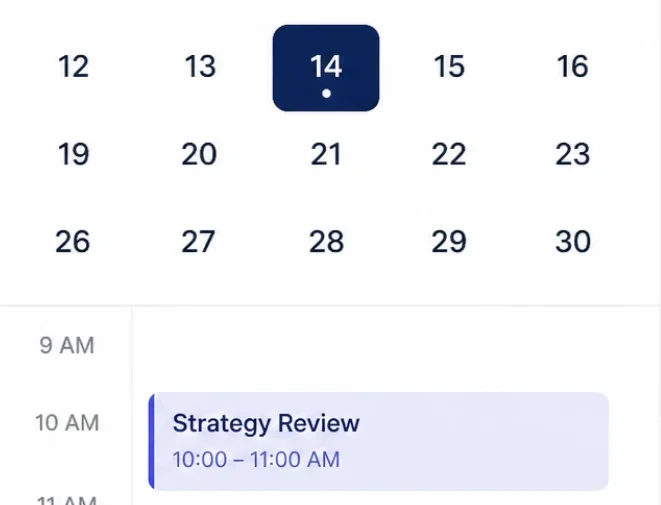
Digital calendar view with a highlighted date and a scheduled meeting block.

Why selling into professional services is different?

Professional services buyers are not evaluating a product. They are choosing a firm they will trust with legal, financial, operational, or technology decisions that directly affect their business. Most outbound approaches are not built for that.

Professional services firms we run campaigns for

Each sub-vertical has a different buyer, a different evaluation cycle, and different circumstances that open a new mandate. We build separate campaigns for each rather than applying shared targeting and messaging across the vertical.

IT and Managed Services Providers

Companies selling cloud, cybersecurity, IT infrastructure, digital transformation, and managed support. Also technology vendors trying to reach IT leadership and operations buyers inside MSP and IT services firms.

Management and Business Consulting

Strategy, operations, and performance improvement practices looking to build pipeline beyond partner networks. Also specialist vendors selling tools or platforms into consulting firm leadership.

Law Firms and Legal Services

Commercial, employment, IP, M&A, and compliance practices building a structured client pipeline. Also legal technology and RegTech vendors targeting General Counsels and senior legal operations buyers.

Accounting and Advisory Firms

Tax, audit, CFO advisory, and Client Advisory Services practices. Also finance technology vendors and outsourced CFO platforms targeting finance leadership at mid-market companies.

HR and People Advisory

Talent strategy, compensation, HRIS implementation, and organisational design firms. Also HR technology vendors targeting people leadership at companies going through headcount or structural change.

Marketing and Creative Agencies

Brand strategy, performance marketing, and digital agencies expanding beyond referrals. Also marketing technology vendors targeting CMO-level buyers at agencies and in-house marketing functions.

What actually moves a professional services deal forward?

Firms do not appoint a new law firm, IT provider, or consultant because they received an email. A change in leadership, structure, or circumstance creates the requirement.

Identifying those accounts before the search begins is how qualified meetings get booked.

New mandates for professional services typically open when:

A new CTO, CFO, CHRO, or Managing Partner joins and reviews the existing provider landscape

A funding round, PE investment, or M&A transaction creates immediate requirements across departments

A regulatory requirement around AI governance, ESG reporting, data privacy, or audit compliance requires specialist input

Headcount growth moves a company past the point where existing provider relationships cover all business needs

How Rev-Empire targets these windows:

Monitors leadership appointment announcements to identify accounts entering an active provider review period

Tracks funding events, M&A activity, and PE investment rounds as entry signals across all sub-verticals

Maps regulatory deadline calendars by sub-vertical to reach firms inside active planning and compliance review periods

Monitors contract expiry windows for IT and managed services accounts, typically at the 18 to 24 month mark

Outcome

We target 6–10 qualified qualified vendor conversations per month with verified decision-maker access and confirmed evaluation timelines.

Built for professional services buying cycles and mandate windows

Meetings booked at Head/ VP/ C-Level
40 -75%+
Outreach sent to verified, active contacts
70 -95%
Average touchpoint for each ICP
1 -9
New target accounts reached monthly
10 -100+

Our professional services lead generation process

Designed for the way professional services mandates are awarded. Each step accounts for the role-based buying structure and longer evaluation cycles typical of this vertical.

1. Sub-vertical ICP definition

We define your ideal account across firm type, size, geography, and the specific circumstances that make a firm ready to evaluate.

2. Buying group identification

For each target account we map the full set of roles involved in awarding a new mandate, covering operational, financial, legal, and governance contacts. 

3. Role-specific multi-channel outreach

We run coordinated email, LinkedIn, and phone outreach across all mapped contacts. Each role receives messaging written for their specific responsibilities.

4. Qualification, booking and handoff

Before a meeting is confirmed we verify the contact's decision-making role, their current evaluation context, and the trigger that opened the mandate. 

How our approach differs from typical
professional services lead generation vendors

Most lead generation providers run the same outbound motion regardless of who the buyer is or how they make decisions.

Our campaigns are focused on specific professional services mandates that require a different process entirely. 

Qualified meetings with professional services decision-makers

Clear scope. Consistent delivery. No long-term lock-in.

📊 Flexible monthly engagement

Pause, scale, or adjust campaigns based on pipeline needs. No long-term contracts or rigid commitments.

👥 Aligned with your internal process

We work within your CRM, handoff flow, and sales structure so your team can pick up conversations without friction.

📅 Built for consistency, not spikes

Campaigns are structured to deliver a steady flow of conversations instead of short bursts that drop off.

Healthcare Industry Page

Professional Services Lead Generation FAQs

Professional services lead generation is the process of opening qualified sales conversations with decision-makers at IT services firms, law practices, consulting firms, accounting and advisory practices, and HR and marketing agencies. It differs from standard B2B lead generation because procurement in these firms does not happen continuously. New mandates open around specific events such as leadership changes, contract renewals, funding activity, and regulatory requirements. Campaigns built around those triggers produce qualified meetings.

It works when it accounts for how these buyers actually make decisions. Managing Partners, General Counsels, CFOs, and CHROs receive consistent volumes of outreach and are quick to identify messages that are untargeted or poorly timed. Outreach that is specific to the firm’s sub-vertical, arrives when a relevant evaluation is underway, and addresses the right person’s actual responsibilities gets a different response entirely. When those conditions are met, outbound reaches new clients that referrals alone would not surface.

Target roles vary by sub-vertical. For IT services and MSP campaigns, primary contacts are the CTO, CIO, and IT Director, with the CFO involved at budget stage. For management consulting, the relevant buyers are the CEO, COO, and Chief Strategy Officer. For law firm campaigns, we reach Managing Partners and Heads of Legal Operations. For accounting and advisory, the CFO and Finance Director are the primary contacts. For HR advisory, we target the CHRO, CPO, and VP of People. In all cases we map the full buying group rather than approaching a single contact.

Most campaigns produce first qualified meetings within 6 to 10 weeks. The early phase covers sub-vertical ICP definition, buying group mapping, and identifying accounts showing active procurement signals before outreach begins. Professional services procurement cycles are longer than most B2B categories, so campaigns are scoped for the full evaluation window. A meeting with a Managing Partner who has a confirmed mandate is worth considerably more than a high volume of early-stage calls with contacts who have no active requirement.

We monitor new leadership appointments across CTO, CFO, CHRO, and Managing Partner roles, as these contacts typically review existing vendor relationships within their first 90 days. We track funding rounds, PE investments, and M&A events that create immediate requirements across legal, IT, advisory, and HR. We identify companies crossing headcount thresholds where informal provider arrangements need to be formalised. For IT and managed services campaigns, we track contract expiry windows at the 18 to 24 month mark. Geographic expansion into new markets or jurisdictions is also a consistent signal for legal, accounting, and IT campaigns.

The buyers, triggers, and evaluation cycles are distinct enough that we build them separately. IT services and MSP campaigns target CTO and CIO-level buyers and are typically triggered by infrastructure failure, contract renewals, or digital transformation mandates, with evaluation cycles running 2 to 6 months. Management consulting campaigns target CEO and COO-level buyers and are triggered by leadership changes, M&A activity, or board-level strategic reviews, with cycles running 3 to 12 months and requiring broader internal alignment. The qualifying criteria, messaging, and stakeholder maps are different for each.

We target 5 to 8 qualified held appointments per month per campaign. The number varies by sub-vertical, geography, and the size of the addressable account universe. Campaigns targeting senior buyers in a niche sub-vertical will have a smaller account pool and a higher average deal value per meeting. We agree targets and qualifying criteria at the scoping stage before the campaign begins.

Both. We run campaigns for vendors selling technology, compliance, and business solutions into professional services firms, reaching General Counsels, CTOs, CFOs, and Managing Partners on their behalf. We also run campaigns for professional services firms building a structured outbound pipeline, including IT services companies, consulting firms, law practices, and accounting and advisory firms. The targeting approach differs between these two contexts and we scope each campaign separately.