Introduction
Tired of chasing prospects that never convert into meetings?
In today’s B2B world, simply booking any meeting won’t cut it. Your goal for 2025 must be high-value sales meetings – the kind that truly convert and drive pipeline growth.
Buyers are smarter than ever, doing their research digitally and often preferring self-serve options. So, how do you break through and get on the calendars of truly engaged decision-makers?
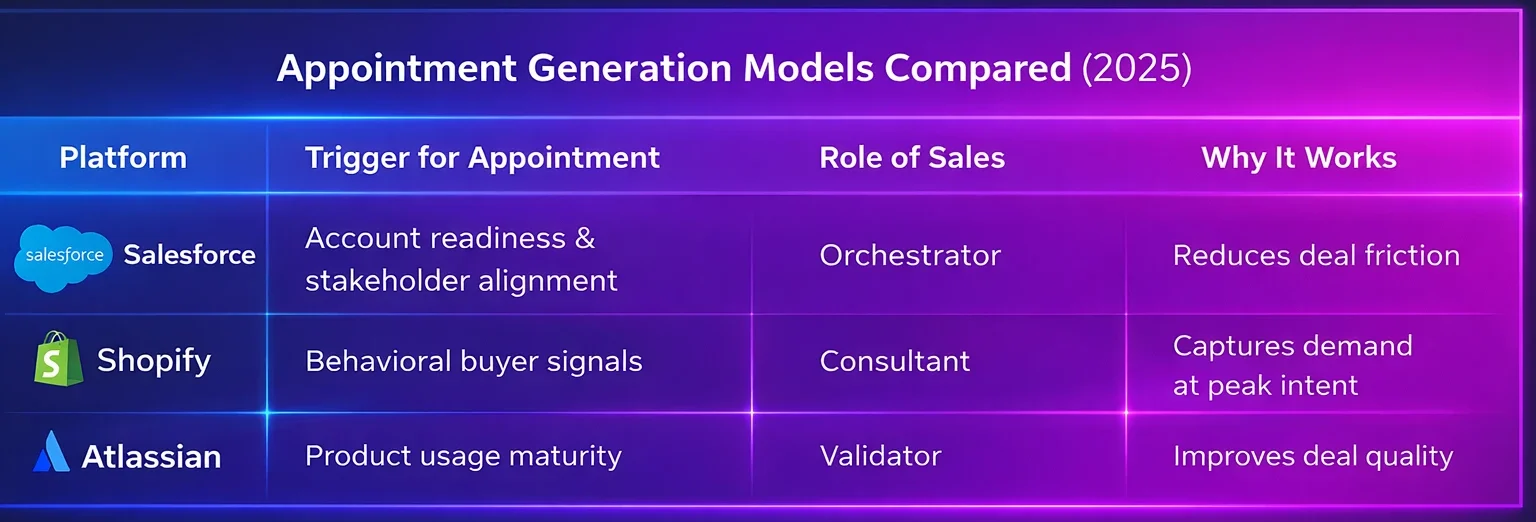
It’s all about adopting smarter, more strategic approaches. We’ve taken deep dives into how the industry’s best operate, and the lessons from Salesforce, Shopify & Atlassian offer a clear blueprint. These companies aren’t just selling; they are mastering the art of appointment generation to connect with prospects who are genuinely ready to talk.
Let’s pull back the curtain and see exactly how these leaders are dominating appointment generation right now.
How Salesforce Drives Enterprise Appointment Generation in 2025
Salesforce, the CRM titan, runs its own sales engine with incredible precision, especially when engaging massive enterprise accounts. Their mastery of appointment generation comes from meticulous insight and strategic engagement.

↠ Becoming a Mind Reader (with Data):
Salesforce’s teams are like detectives. They expertly blend your website visits, content downloads, and even how you interact with their products (if you are a trial user) to understand your true intent.
They also watch public signals – like new funding rounds or key hires in your company.This helps them know who is seriously interested and when they’re most open to a conversation for a high-value appointment.
↠ Messages That Matter:
For big enterprise deals, personalization means showing you’ve done your homework. A Salesforce invitation for an appointment isn’t generic; it might reference a recent company announcement or a specific industry challenge you are facing.
The aim is to offer a strategic discussion about a problem you are likely grappling with, making the appointment itself feel like a valuable consultation.
↠ The Multi-Touch Symphony:
Securing an appointment with an executive often involves multiple people on their end—typically 6 to 10 stakeholders are involved in a B2B buying decision.
Salesforce’s teams use a carefully planned sequence of emails, LinkedIn messages, and well-timed phone calls. It’s a well-composed symphony where each note builds on the last, designed to pique interest and lead naturally to that crucial appointment.
They also effectively convert engaged attendees from industry events and webinars into high-quality appointments.
📌 Key Lesson from Salesforce:
For high-value appointment generation in complex B2B environments, unparalleled account intelligence and ultra-personalized, multi-channel outreach are essential. Your initial appointment is a strategic discussion, not a pitch.
How Shopify Turns Growth Signals into Strategic Merchant Appointments
Shopify empowers millions of businesses to sell online.While many find Shopify through their product, the company’s growth and partnership teams are experts at converting high-potential merchants into strategic conversations, offering vital lessons for appointment generation.

↠ Signals from Success:
Imagine you are a Shopify merchant whose sales have suddenly skyrocketed. Shopify’s teams notice that immediately.
They pay attention to rapid sales growth, how you are using advanced features, or if you are engaging with their scaling-focused content.
These are “growth signals” that indicate you might be ready for a deeper, strategic conversation and a valuable appointment.
↠ Value That Solves Problems:
Their invitations for appointments aren’t about selling more Shopify; they are about helping you succeed even more.
If you are seeing massive growth, an invitation might say, “We noticed your amazing sales spike last quarter. We’ve helped other fast-growing merchants navigate [specific scaling challenge] with [solution]. Would 20 minutes be valuable to discuss strategies to keep that momentum going?”
It’s all about helping you overcome your next hurdle.
↠ Community & Connections:
Beyond direct outreach, Shopify also thrives on its vast network of partners – agencies, app developers, and consultants.
These partners often act as warm introducers, connecting high-potential merchants with Shopify specialists when there’s a clear need for a deeper, strategic conversation, effectively driving appointment generation.
📌 Key Lesson from Shopify:
Your existing users and partners are a goldmine for high-value appointment generation. Look for signals of growth or specific challenges within your customer base, and frame your appointment offers around unlocking their next level of success.
How Atlassian Uses Product Adoption to Generate Enterprise Appointment Generation
Atlassian, makers of tools like Jira and Confluence, built their empire on “product-led growth” (PLG) – meaning users often discover and adopt their products on their own.
But for big enterprise deals, they masterfully turn product usage into strategic appointment generation.

↠ In-Product Clues:
Atlassian’s secret lies in how they monitor how people are using their products. If a large team is heavily using a free version of Jira, or if the are trying to integrate Atlassian tools with other complex enterprise systems, these are huge signals of potential.
It tells Atlassian, “This company is serious, and they need help scaling.” This data-driven insight is crucial for their appointment generation efforts.
↠Appointment Offers Rooted in Reality:
Their invitations for appointments are hyper-specific to the prospect’s actual usage. For instance, if your team is struggling with a particular workflow in Jira, the invite might suggest a call to “optimize your team’s workflow and scale Jira for enterprise use, based on your current project volume.”
It’s about solving their real-world operational puzzles.
↠Enabling, Not Just Selling:
Atlassian’s sales support often steps in as a consultant. They are not just trying to push a product; they’re offering to help customers maximize their investment, solve integration headaches, or facilitate large-scale adoption.
This consultative approach naturally leads to high-value strategic appointments.
📌 Key Lesson from Atlassian:
Even if your product sells itself for basic use, strategic sales engagement driven by deep product usage insights is crucial for securing high-value, expansion-focused appointment generation at the enterprise level.
Recent Developments at Salesforce, Shopify and Atlassian
1. Salesforce Summer ’25 (June 2025) – AI-powered sales assistant features:
The Summer ’25 release added major AI tools under “Agentforce” for Sales Cloud. For example, Salesforce now uses AI to auto-suggest opportunity updates (“Next Steps”) and stage progressions based on conversation data, and it can generate personalized outreach not only on Leads but also on Contacts and Person Accounts.
These features automatically draft follow-ups and schedule tasks after calls, helping reps keep deals moving with less manual work.
2. Salesforce Winter ’26 (Sept 2025) – Lead generation bots and pipeline automation:
The Winter ’26 release introduced “Agentforce for Sales: Lead Generation” – an AI agent that engages website visitors, qualifies them, and even books meetings without human intervention.
It also added Pipeline Management Enhancements: after a sales call, Salesforce and Slack can now prompt the rep with AI-generated next actions, such as drafting a follow-up email or automatically scheduling the next meeting.
Together these updates make it possible for Salesforce’s AI to convert inbound interest into appointments and to keep opportunities updated automatically.
3. Salesforce-Qualified acquisition (Dec 2025) – Conversational marketing:
In mid-December 2025 Salesforce announced the definitive agreement to acquire Qualified, an AI-driven conversational marketing platform. Qualified’s “always-on” chatbot engages site visitors in real time to qualify and nurture leads, and it has built-in meeting scheduling capabilities.
Integrating Qualified into Salesforce will let users deploy chatbots on their websites that automatically book sales appointments and convert anonymous traffic into pipeline – a big boost for appointment generation.
4. LinkedIn Sales Navigator AI (2025) – AI sales assistant:
LinkedIn added several AI tools to its Sales Navigator in 2025. Its Account IQ feature uses AI to generate quick summaries and next-step suggestions for target accounts (to prep for meetings), and Lead IQ offers AI-suggested lead insights and outreach tipsbusiness.linkedin.com. Most importantly, LinkedIn is beta-testing a “Sales Assistant” AI agent that automates prospecting: it delivers the best leads, drafts personalized outreach messages, and even helps book more sales meetingd.
These LinkedIn features mean B2B sellers now have AI help identifying and messaging prospects – directly feeding into getting appointments.
5. Shopify + ChatGPT (Sept 2025) – Commerce in AI chat:
Shopify announced a partnership with OpenAI so merchants can sell products directly within ChatGPT conversations. In practice, a customer can ask ChatGPT to recommend a product and purchase it on the spot, without leaving the chat. Shopify turns merchant inventory and product info into an AI-friendly format, making millions of SKUs discoverable in chat.
This shift toward “conversational commerce” means sales opportunities (and appointments for bigger sales) can arise in any AI chat, not just on websites or in email.
6. Shopify Winter ’26 (Dec 2025) – Agentic Storefronts:
Part of Shopify’s Winter ’26 edition was Agentic Storefronts. With this feature, Shopify merchants can syndicate their product catalogs to AI chat platforms like ChatGPT, Microsoft Copilot, or Perplexity through a one-time setup. Agents then present the brand accurately and let shoppers buy or even schedule demos (for B2B) right in the conversation.
Shopify handles checkout and attribution across all these agents.
In effect, this means a Shopify business becomes “agent-ready” by default – any AI conversation becomes a potential sales channel and appointment generator.
7. Atlassian Service Collection (Oct 2025) – Unified service + AI:
At Atlassian’s Team ’25 event (Oct 2025), Atlassian launched its Service Collection, bundling Jira Service Management (internal ITSM), a new Customer Service Management (CSM) app (external customer support), Assets, and Rovo AI agents into one package. The new CSM is purpose-built for support teams and includes AI-driven support agents plus CRM integrations.
For appointment generation, this matters because it means Atlassian can now handle both internal and external customer queries seamlessly with AI assistants – making scheduling support calls or demos more efficient across the board.
Your Blueprint for High-Value Appointment Generation in 2025
The lessons from Salesforce, Shopify & Atlassian offer a powerful blueprint for mastering high-value appointment generation in 2025. It’s about being strategic, relevant, and leveraging smart tools:
✅ Be a Data Detective for Intent:
Go beyond basic firmographics. Synthesize first-party data (website, CRM, product usage) with third-party behavioral signals to pinpoint prospects and buying groups that are actively researching and signaling readiness for a valuable discussion.
Companies effectively using intent data are significantly more likely to achieve high outbound conversion rates.
✅ Personalize with Purpose:
Ditch generic templates. Personalize your outreach not just with their name, but with insights specific to their business, industry, or even recent news. This level of personalization makes your invitation impossible to ignore.
Personalized CTAs (Calls to Action) can outperform generic ones by 202%.
✅ Orchestrate Your Outreach Smartly:
Don’t put all your eggs in one basket. Use a smart mix of email, LinkedIn, and phone. Achieving an appointment often takes persistence – sales outreach response rates can be low initially, with over 60% of replies happening after the third touchpoint.
A well-planned multi-channel campaign can lead to a 287% higher purchase rate than single-channel campaigns.
✅ Embrace Human-AI Synergy:
Use AI to handle the tedious tasks: finding leads, enriching data, even drafting initial personalized message frameworks. This frees your sales team to focus on the truly human parts: deep research, crafting compelling value propositions, and building relationships.
For Go-to-Market teams, using AI functionality has led to a 35% higher win rate. And don’t worry about automation feeling cold; 39% of consumers are already comfortable with AI scheduling.
✅ Focus on “Why Meet?” Not “What Do I Sell?”:
Every request for an appointment should clearly articulate the unique, valuable outcome the prospect will gain by spending time with you. It’s always about what’s in it for them.
What These Appointment Generation Updates Mean Heading Into 2026
1. AI will handle routine scheduling:
By 2026, sales teams can expect AI to take over the busywork of calendars. Google’s Gmail already auto-suggests meeting times with Gemini, and Salesforce’s pipeline tools can now draft follow-ups and even schedule next meetings.
In practical terms, most of the back-and-forth to book standard calls or demos will be automated. Sellers should prepare to let these tools seed calendar invites and focus their effort on personalizing the meeting content.
2. Every conversation can lead to commerce or demos:
The rise of “conversational commerce” means that chatting with an AI will become a direct sales channel. Shopify’s Agentic Storefronts ensure brands show up in any AI chat, and LinkedIn’s Sales Assistant AI is built to “help you book more sales meetings”.
By 2026, talking to an AI chatbot could directly result in scheduling a product demo or sales call. Sales and marketing teams will need to optimize how their products and services appear in these AI conversations (e.g., being ready with promo info or easy scheduler links) so that any AI-driven lead is smoothly captured as an appointment.
3. Data-driven personalization wins out:
The tools already merging CRM and AI (Salesforce Data Cloud’s AI tagging, LinkedIn’s Account IQ, etc.) will make outreach far smarter. Instead of blasting generic emails, sellers will have AI summaries of each prospect’s needs and AI-generated message drafts.
By 2026, appointment campaigns will be powered by these insights: AI will highlight which leads to call and what to say. The outcome is that prospects feel more understood, so more meetings actually get booked.
4. Integration is key:
With platforms converging (Atlassian’s CRM-integrated service tools, Shopify’s connected AI storefronts, Salesforce linking Slack and Calendar, etc.), all parts of the sales and support tech stack will connect. This means calendars, CRMs, and messaging apps will sync data seamlessly.
Heading into 2026, companies should expect their appointment scheduler to be tightly integrated: a lead response in one system (like a website chat or LinkedIn message) can automatically trigger tasks in another (like a Salesforce event or Atlassian ticket).
In practice, this connected ecosystem will make appointment generation more automatic and reliable – as long as teams set up those connections.
Ready to Revolutionize Your Appointment Generation?
Navigating the complexities of B2B appointment generation demands a strategic partner.
At Rev-Empire, we specialize in helping B2B businesses like yours implement these cutting-edge strategies to secure high-value appointments. We go beyond just booking appointments; we focus on attracting the right conversations that fill your pipeline with genuinely qualified opportunities.
Stop wasting time on low-quality leads. Let us help you craft a tailored appointment generation strategy that drives real revenue, using the lessons from industry leaders like Salesforce, Shopify, and Atlassian.
Reach out to us for a free sales consultation at contact@rev-empire.com