
What is B2B lead scoring?
B2B lead scoring is a system for ranking prospects according to their fit, engagement and buying signals. Relevant attributes and actions receive positive or negative values, helping sales teams decide who needs immediate follow-up, who should be nurtured and who should be deprioritized.
The most reliable models keep fit and engagement visible separately. This prevents an unsuitable but highly active contact from being treated the same as a well-matched decision-maker showing genuine buying intent.
Table of contents
What lead scoring does
Lead scoring turns qualification criteria into a consistent system. Instead of treating every new contact, form submission or campaign response equally, it evaluates whether the prospect resembles your ideal customer and whether their behaviour suggests a genuine reason to engage.
A score should help answer three practical questions:
- Is this person and company a suitable fit for what we sell?
- Have they shown meaningful interest or a credible buying signal?
- What should sales or marketing do next?
The score itself is not the objective. Its purpose is to improve prioritization, routing and follow-up. A model is useful only when a score leads to a clear action.
Important: lead scoring is not a substitute for qualification. It helps determine where attention should go first, but sales still needs to confirm the prospect's situation, need, authority, timing and potential fit.
Why lead scoring matters for B2B teams
A practical scoring model improves the way marketing, business development and sales manage limited time. Its value comes from creating better decisions rather than generating another CRM number.
Better prioritization
Sales can focus first on prospects who combine strong fit with meaningful interest or buying signals.
Faster follow-up
High-intent enquiries and qualified campaign responses can be routed quickly instead of waiting in a general queue.
Shared qualification rules
Marketing and sales work from the same definition of a high-priority lead and can identify where disagreements occur.
Cleaner pipeline decisions
Poor-fit contacts, stale activity and unreliable signals are less likely to inflate qualified-lead numbers.
Fit scoring versus engagement scoring
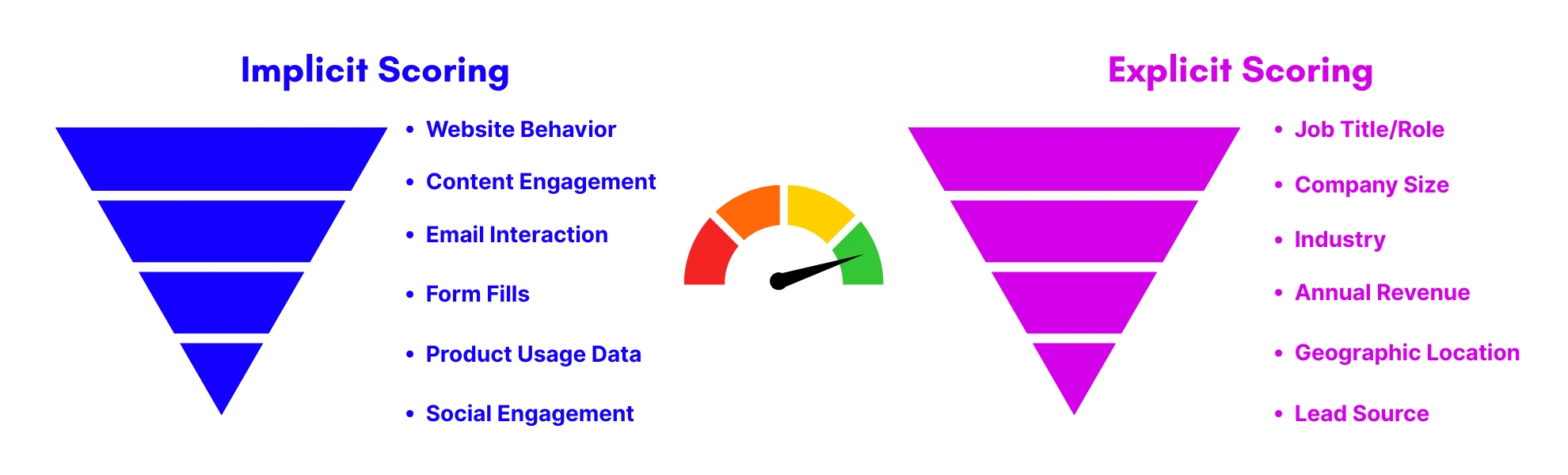
A strong B2B model normally combines two different types of information. Fit scoring evaluates who the prospect is. Engagement scoring evaluates what the prospect has done.
Fit scoring: who they are
Fit scoring, sometimes called explicit scoring, measures how closely a contact or company matches your ideal customer profile. Common criteria include:
- Industry or market segment
- Company size and revenue range
- Geographic location
- Role, department and seniority
- Business model or service requirement
- Technology, facility or operational characteristics
- Whether the company is inside your serviceable market
Engagement scoring: what they do
Engagement scoring, sometimes called implicit scoring, measures actions that may indicate interest or readiness. Useful signals can include:
- Submitting a contact, consultation or demo form
- Replying positively to outbound communication
- Repeated visits to a relevant service or pricing page
- Using an assessment, calculator or comparison tool
- Attending a relevant event or webinar
- Starting a trial or using important product features
- Several contacts from the same account engaging with the business
Email opens should receive little or no weight. Privacy features, security scanners and automated previews can create activity that does not represent real human interest. Replies, form submissions, booked meetings and meaningful product actions are generally more dependable.
Fit and engagement priority matrix
Keep the two dimensions visible instead of relying only on one combined number.
How to build a practical lead scoring model
Start with a model that sales and marketing can understand. A smaller set of evidence-based rules is normally more useful than a complex model containing every available CRM field and website action.
Define your ideal customer profile
Identify the company attributes that consistently produce suitable customers. Include industry, size, geography, operational requirements and genuine exclusions.
Define the relevant people
List the roles involved in identifying the need, evaluating the solution, approving the purchase and using the service. Do not assume only C-level contacts have value.
Identify meaningful intent signals
Choose actions that suggest an actual problem, evaluation or request. Give stronger weight to replies, forms, repeated high-intent behaviour and relevant product activity.
Add negative and disqualification criteria
Reduce scores for poor fit, unsubscribes, job-seeking activity, unsuitable personal email addresses, competitors, unsupported regions and prolonged inactivity.
Assign provisional values
Weight criteria according to their expected relationship with qualified opportunities. Treat the initial values as a hypothesis that needs to be tested.
Create score bands and actions
Define what happens at each level. Low scores may remain in nurture, medium scores may require review and high scores may trigger direct sales follow-up.
Test against actual outcomes
Compare score bands with accepted leads, meetings, opportunities and revenue. Adjust rules when the scores do not predict useful commercial outcomes.
Example B2B lead scoring framework
The values below are examples, not universal benchmarks. Your model should reflect your target market, sales process and historical conversions.
| Category | Example criterion or action | Sample value | Reason |
|---|---|---|---|
| Company fit | Matches the target industry | +15 | Indicates basic market suitability |
| Company fit | Matches the target company-size range | +15 | Suggests appropriate scale and potential need |
| Contact fit | Relevant decision-maker or operational stakeholder | +15 | Contact can influence or support the buying process |
| Direct intent | Submits a consultation, contact or demo request | +30 | Clear request for a sales conversation |
| Outbound response | Replies positively to relevant outreach | +25 | Verifiable engagement with the proposition |
| Website intent | Revisits a service or pricing page | +10 | Suggests evaluation but still needs context |
| Content engagement | Uses a relevant calculator or assessment | +10 | Shows engagement with a specific business problem |
| Event engagement | Attends a relevant webinar or event | +8 | Useful interest signal but not always buying intent |
| Data quality | Uses a personal email for a B2B purchase | −10 | May make company verification more difficult |
| Disqualification | Student, job seeker, vendor or irrelevant enquiry | −20 | Activity does not represent a suitable buyer |
| Territory | Outside the serviceable market | −30 | Business cannot currently serve the opportunity |
| Recency | No meaningful activity for 30 days | −10 | Reduces the influence of old engagement |
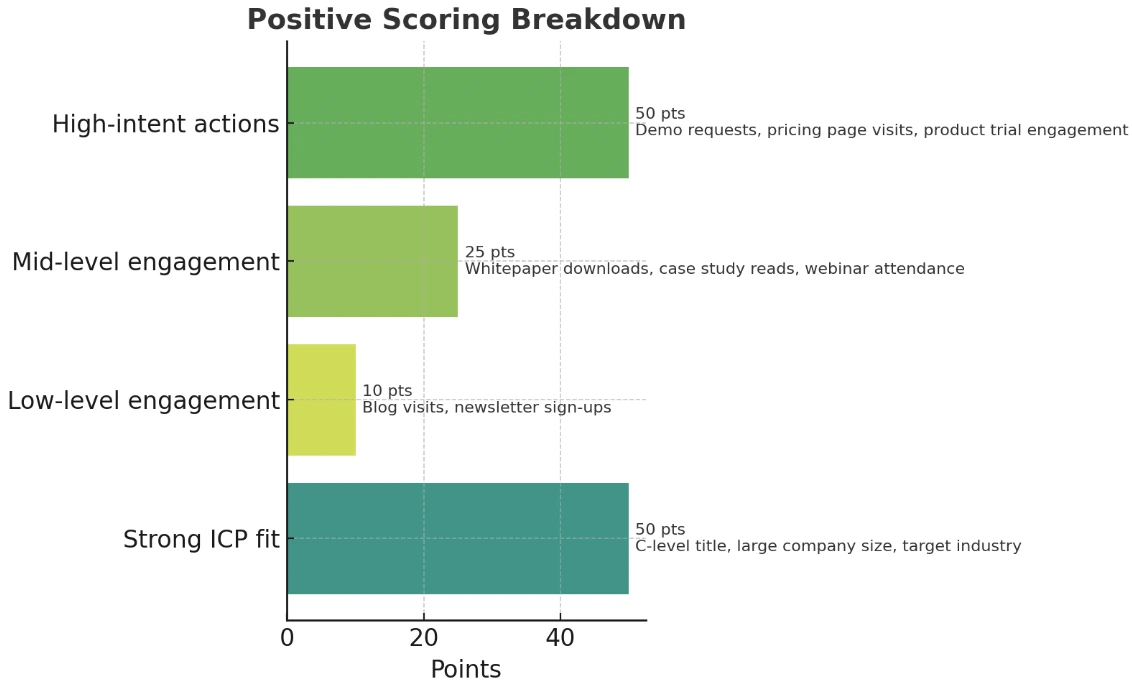
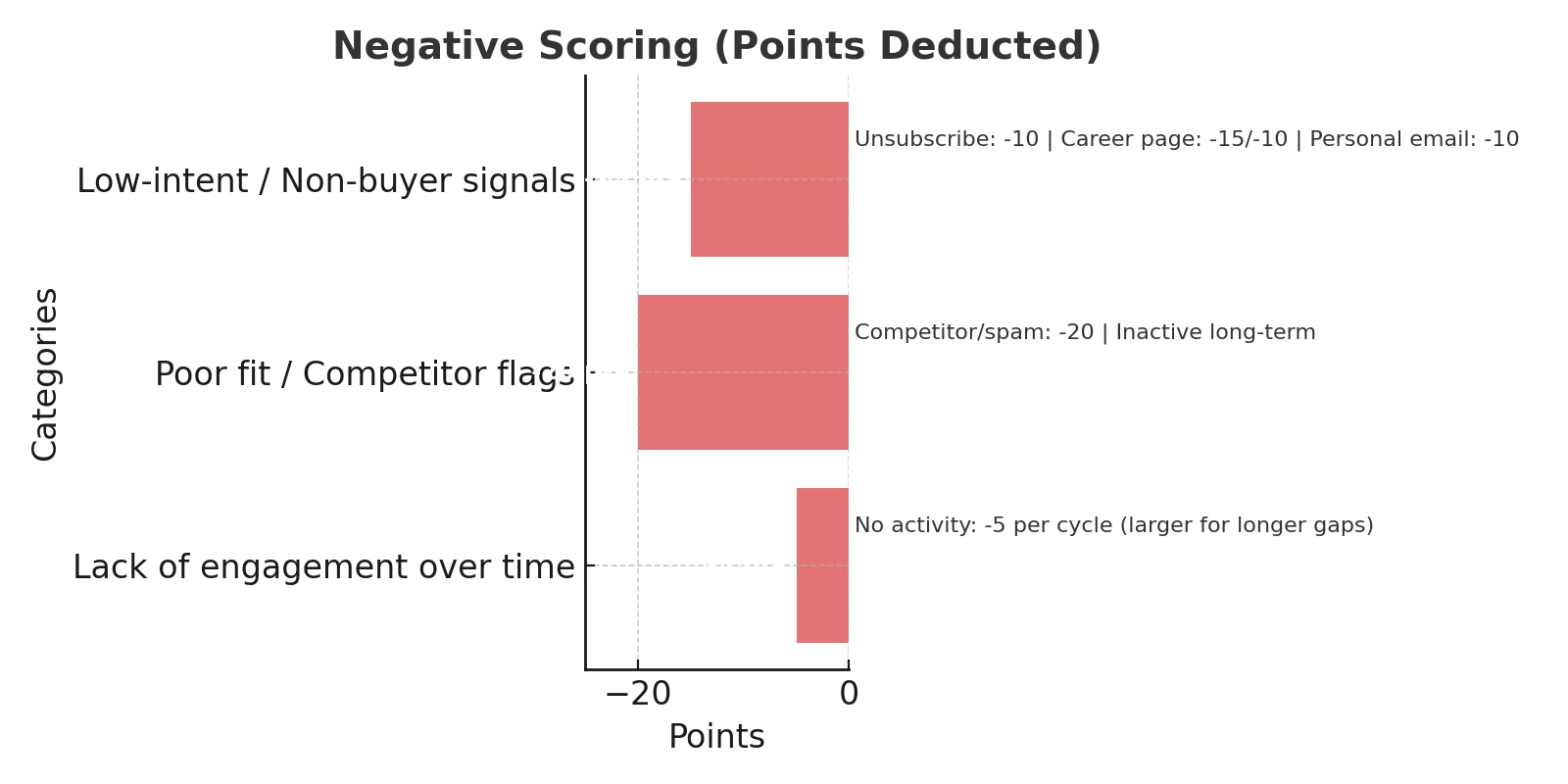
Why the values must be tested
A job title may appear important without predicting conversion. A webinar registration may show interest without indicating a current need. Conversely, a reply from a relevant operational stakeholder may be more valuable than passive activity from a senior executive.
Review which criteria appear most often among accepted leads, opportunities and customers. Raise or lower the values according to evidence, not assumptions.
Setting a sales-ready threshold
A threshold determines when a lead moves from nurture or review into direct sales follow-up. There is no universal number that makes a lead sales-ready. The correct threshold depends on the number and weight of your scoring rules.
Keep in nurture, enrich missing information or deprioritize when fit is also weak.
Check account fit, recent activity and whether additional qualification is needed.
Route for timely follow-up, provided the minimum fit conditions have also been met.
These ranges are illustrative. A prospect should not reach the sales queue through engagement points alone. Consider requiring minimum fit conditions in addition to the combined threshold.
Example routing rule: route a lead to sales only when the combined score is at least 60, the company is inside the target market and the fit score is at least 25.
Advanced signals that improve scoring accuracy
Product or service usage
Repeated use of important features, team adoption, usage limits and integration activity may indicate an expansion or sales opportunity.
High-intent content
Pricing, security, integration, comparison and implementation pages normally indicate more intent than a general blog visit.
Account-level engagement
Activity from several people at the same company may indicate a buying group evaluating the problem together.
Business-change signals
Hiring, funding, expansion, leadership changes, renewals or operational changes may create a reason for timely outreach.
Third-party intent
External research and review-site activity can help identify in-market accounts but should be combined with fit and verified engagement.
Lead decay
Reduce the influence of old activity so inactive contacts do not remain permanently prioritized.
How lead decay works
Interest changes over time. Without lead decay, a contact can remain highly scored because of a pricing-page visit, webinar registration or campaign response that happened months earlier.
A simple model might deduct points after 30 days without meaningful activity and apply a larger reduction after 60 or 90 days. Direct replies, new form submissions or renewed product activity can refresh the engagement score.
Decay rules should normally affect engagement points rather than stable fit criteria. A company may remain a good fit even when its current interest has cooled.
How to measure whether your scoring model works
A model should be evaluated by the outcomes it predicts. Do not judge it only by how many contacts cross the threshold.
If high-scoring leads do not convert better than medium or low-scoring leads, revisit the criteria, values, thresholds and data quality.
Sales and marketing alignment for lead scoring
Scoring works best when sales and marketing agree on the model and share responsibility for improving it. A model built entirely by one team is less likely to be trusted or used by the other.
Agree on the qualification definition
Document the minimum company fit, relevant roles, meaningful intent signals and disqualifying conditions.
Create follow-up service levels
Define what happens when a lead reaches each score band. A direct consultation request may require immediate follow-up, while a moderate score may trigger research or nurture.
Use closed-loop feedback
Sales should record why routed leads were accepted, rejected or disqualified. Marketing and revenue operations can then identify rules producing false positives or missing good opportunities.
Review the model regularly
Review performance quarterly and whenever the target market, service, sales process or data collection changes.
For a deeper qualification framework, read our B2B lead qualification checklist .
Lead scoring in HubSpot and Salesforce
Most major CRM platforms can automate scoring, routing and reporting. Exact capabilities depend on the platform and subscription.
HubSpot lead scoring
HubSpot supports fit, engagement and combined scores using property values and event activity. Teams can use score properties in segments, workflows and reporting.
Salesforce lead scoring
Salesforce teams can build scoring rules or use Einstein Lead Scoring where eligible. Predictive scoring still depends on accurate historical data and ongoing sales feedback.
Start with the process, not the software. CRM automation cannot repair unclear qualification rules, inconsistent data or a lack of follow-up ownership.
If your lifecycle stages, routing or data structure need improvement, explore our CRM optimization service .
Common lead scoring mistakes to avoid
1. Overcomplicating the first model
Too many criteria make the model difficult to understand, maintain and validate. Begin with factors closely connected to fit and meaningful action.
2. Giving every activity points
A blog visit, email open and consultation request do not show the same intent. Score actions according to their commercial meaning.
3. Allowing engagement to override poor fit
An active student, vendor, competitor or job seeker may collect more points than a suitable buyer. Use minimum fit requirements and negative scoring.
4. Giving seniority too much weight
Senior executives are not automatically better prospects. The person closest to the operational problem may be the best initial contact.
5. Ignoring negative scoring and decay
Without deductions, poor-fit and inactive contacts accumulate points but rarely move down the queue.
6. Using one model for every market
Different services, company sizes, regions and sales motions may require different criteria or thresholds.
7. Setting a threshold without testing it
A number such as 50 or 100 has no inherent meaning. Validate whether leads above the threshold convert more consistently.
8. Leaving sales out of model reviews
Sales feedback is necessary to understand why scored leads convert, stall or get rejected.
Lead scoring implementation checklist
A useful model does not need to be complicated. It needs to be clear, measurable and connected to a next action.
Before activating your model, confirm that:
- Your ideal customer profile is clearly documented.
- Fit and engagement are measured separately.
- High-intent actions outweigh passive activity.
- Negative and disqualification rules are included.
- Old engagement loses weight through lead decay.
- Every score band has an owner and next action.
- Sales can record acceptance and rejection reasons.
- The model will be evaluated against commercial outcomes.
- A quarterly review process has been assigned.
Lead scoring works when it helps the right prospects receive the right response at the right time. Keep the initial framework simple, learn from actual outcomes and improve it as your data becomes more reliable.
Build your first lead scoring model
Use Rev-Empire's free four-step template to define fit, engagement, negative scoring and sales-ready thresholds in one practical framework.
Download the lead scoring templateFAQs about B2B lead scoring
What is lead scoring?
Lead scoring is a system for ranking prospects according to characteristics and actions associated with customer fit and buying readiness. It helps teams prioritize follow-up, nurture developing opportunities and deprioritize unsuitable contacts.
How do you calculate a lead score?
Identify relevant fit, engagement and disqualification criteria, assign positive or negative values and add the applicable values for each lead. Compare the result with defined priority bands or sales-ready thresholds.
What criteria should be included in a B2B lead scoring model?
Common criteria include industry, company size, geography, role, seniority, service requirements, form submissions, positive replies, high-intent page visits, product usage and event activity. Include negative criteria for poor fit, irrelevant enquiries and inactivity.
What is the difference between fit and engagement scoring?
Fit scoring measures whether the person and company resemble your ideal customer. Engagement scoring measures actions that may indicate interest or readiness. A strong model uses both.
What is negative lead scoring?
Negative lead scoring subtracts points for conditions that make a prospect less suitable or less ready. Examples include being outside the target market, submitting an irrelevant enquiry, unsubscribing or having no meaningful activity for an extended period.
How do you choose a sales-ready score?
Start with a provisional threshold based on your scoring structure. Compare leads above and below it using sales acceptance, meeting, opportunity and customer conversion data, then adjust the threshold.
How often should a lead scoring model be reviewed?
Review the model at least quarterly and whenever the target market, offer, sales process or data collection changes. Use sales feedback and conversion results to refine it.
Can HubSpot and Salesforce automate lead scoring?
Yes. HubSpot and Salesforce provide lead-scoring capabilities, although available scoring types, automation and predictive features depend on the platform and subscription.