Introduction: Why scaling email marketing changes with company stage
Email is still one of the most effective channels in 2025, but how you scale it depends heavily on your company stage.
Startups with ten employees can’t approach outreach the same way as enterprises with thousands. The challenges, risks, and opportunities shift as teams grow.
For startups, the tension is speed versus quality. For SMEs, it’s predictability versus over-automation. For enterprises, it’s governance versus growth.
In this blog, we’ll break down how each stage should think about scaling email marketing, highlight the latest statistics, and share Rev-Empire’s unique approach that combines automated AI campaigns with manual Microsoft 365 sends.
1. Email Marketing for Startups
Key challenges startups face in email marketing
Startups are under unique pressure. With limited people, limited money, and the need for traction fast, email can feel like the easiest lever to pull.
But most founders run into the same problems:
Founder-led outreach: The CEO or co-founder often writes and sends every email. This eats into time needed for product and fundraising.
Tiny or messy lists: Data comes from scraping LinkedIn or old spreadsheets. Verification is skipped to save time, leading to high bounce rates.
Chasing volume too early: Many send hundreds of emails hoping for luck, which quickly damages the domain and lowers deliverability.
No clear learning loop: Emails are sent, but no one reviews open rates, reply rates, or objections systematically. Lessons are lost.
Overlooking relationship value: The goal becomes “get a call at any cost” rather than starting genuine conversations with the right people.
Tactics That Work for Startup Email Outreach
The key for startups is to slow down and optimize for quality before scale. Practical approaches include:
Micro-lists of 50–100 prospects per week: Each name should be hand-picked based on clear signs of interest—funding rounds, job postings, product launches, or technology changes. This keeps volume manageable and targeting sharp.
Write like a person, not a pitch deck: Use a simple opener that shows awareness of the recipient’s context. Keep it under 140 words with one concrete ask such as “Would you be open to a 10-minute intro call?”
Use founder authority: Early buyers often respond because the email comes directly from the founder. Lean into this—sign emails with your name, not “Sales Team.”
Set up a weekly review rhythm: Every Friday, check subject line performance, reply quality, and common objections. Adjust before the next send rather than repeating the same mistakes.
Warm up and protect the domain: Run emails through warm-up tools for at least 2–3 weeks before real sending. Early damage to a domain can take months to undo.
Email marketing tools stack for startups
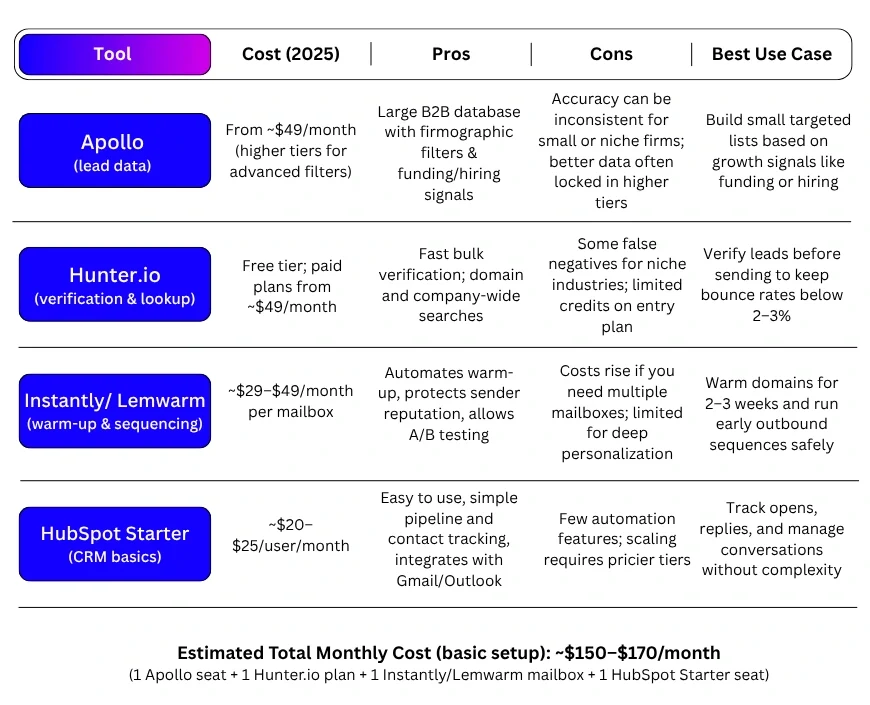
Email marketing benchmarks for startups in 2025
In 2025, the average cold email reply rate is ~4.1% (Hunter.io). Startups with small, well-targeted lists often reach reply rates of 7–10%.
Belkins’ 2025 study reports that 6–8 sentence emails earn open rates of 42.67% and reply rates of 6.9%.
When sending to unverified large lists (1,000+ contacts), reply rates drop to ~2.1% (SalesHandy 2025).
Using these tools smartly (verified lists, warmed domains, CRM tracking) can help startups outperform mass outbound and protect domain health early on.
→ For founders who want to move beyond late-night outreach, our Lead Generation Services provide structure, verified data, and tested sequences so you can focus on meaningful conversations rather than email mechanics.
2. Email Marketing for SMEs
Key challenges SMEs face in email marketing:
At this stage, the business has a few SDRs or a marketing team member responsible for email. The founder is less hands-on, but new problems appear:
Need for predictability: Revenue targets now depend on consistent meetings booked each month. Random spikes and droughts are no longer acceptable.
Limited bandwidth: Teams juggle multiple campaigns and channels. Without structure, follow-ups get missed.
Over-reliance on automation: To save time, some SMEs over-automate sequences. This leads to robotic copy and declining response rates.
Data quality at scale: Pulling 1,000+ contacts often introduces duplicates, old emails, or irrelevant titles that damage deliverability.
Testing fatigue: Teams want to A/B test but struggle to keep experiments organized across campaigns.
Email marketing tactics that work for SMEs
Segment campaigns by buyer persona: Instead of one mass send, create smaller campaigns for founders, marketing heads, and operations leads. Tailor opening lines and offers for each.
Run structured A/B tests: Choose one variable (subject line, CTA, or offer) at a time. Run at least 100–200 sends per test to get meaningful data. Mailshake reports 2025 campaigns that actively test improve reply rates by ~27% compared to static campaigns.
Automate follow-ups but review copy: First touch and final follow-up should always be human-reviewed. Middle follow-ups can be automated for efficiency.
Align email with other signals: Connect campaigns with LinkedIn touches, intent data, or website visits. This raises relevance and shortens cycles.
Set a cadence calendar: Plan weekly sends, review results bi-weekly, and rotate subject lines monthly. This avoids “overheating” lists and keeps performance steady.
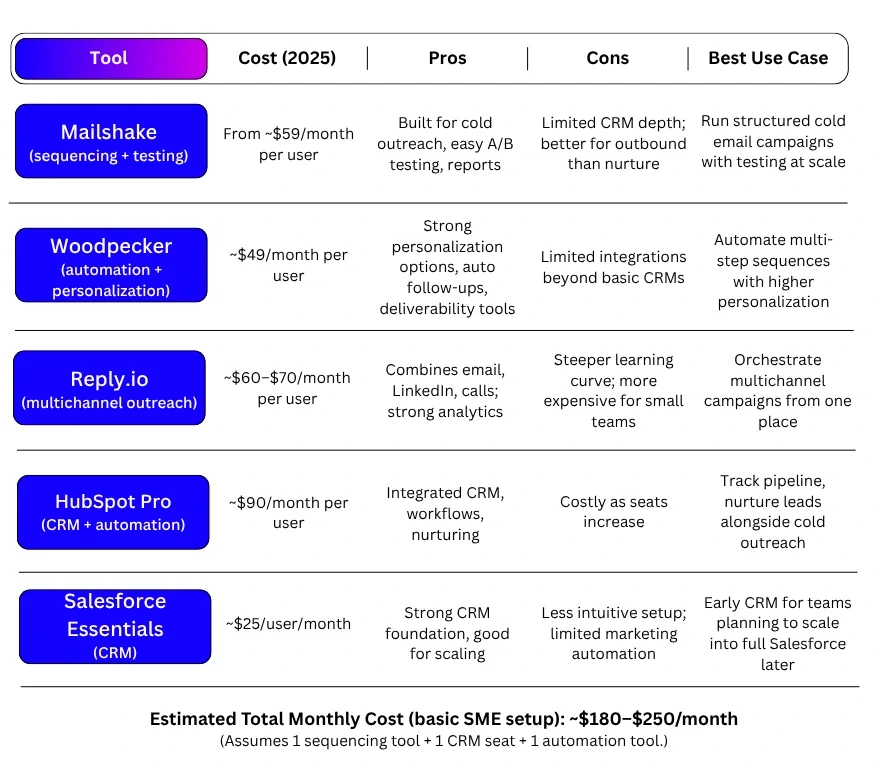
Email marketing benchmarks for SMEs
Email ROI remains high: $36 for every $1 spent (OptinMonster, 2025).
SMEs that segment by persona and intent often see 20–30% higher reply rates than generic sends.
Deliverability is a key risk: lists over 1,000 unverified contacts average 2–3% reply rates, versus 8–10% for segmented campaigns under 500 recipients.
→ For SMEs who need predictable pipelines without losing the “human touch,” our Email Marketing Services provide structured campaigns, A/B testing, and QA so teams don’t fall into the automation trap.
3. Email Marketing for Enterprises
Key challenges Enterprise businesses face in email marketing
At enterprise scale, the risks shift from “how do we book meetings” to “how do we protect brand trust while running hundreds of campaigns across regions.” The problems are bigger, and mistakes are more costly:
Compliance and legal oversight: Data privacy rules (GDPR, CCPA, regional spam laws) mean every campaign must pass strict review. One slip can cause legal or reputational damage.
Domain reputation risk: Enterprises send from multiple domains and mailboxes. If one domain gets blacklisted, it can affect the whole organization.
Multi-region complexity: Global enterprises can’t use the same copy everywhere. Local regulations and buyer expectations demand localized campaigns.
Overlapping outreach: Different business units often email the same accounts without coordination, causing prospect fatigue.
Brand dilution: Over-automation risks creating robotic, impersonal outreach that undermines brand credibility.
Email marketing tactics that work for enterprises
Domain pools and rotation: Spread campaigns across multiple domains and rotate every 3–6 months. Use seed accounts and tools to monitor deliverability health.
Regional localization: Build region-specific templates (e.g., EMEA vs APAC vs US). Adjust tone, legal footers, and cultural references.
ABM + CRM integration: Sync email with Account-Based Marketing and CRM platforms so multiple teams don’t overlap messaging.
Governance committees: Establish central oversight for outbound strategy, ensuring legal compliance, domain management, and consistent messaging across divisions.
Fallback workflows: Have backup sending domains and playbooks ready if a region’s campaign suffers deliverability drops.
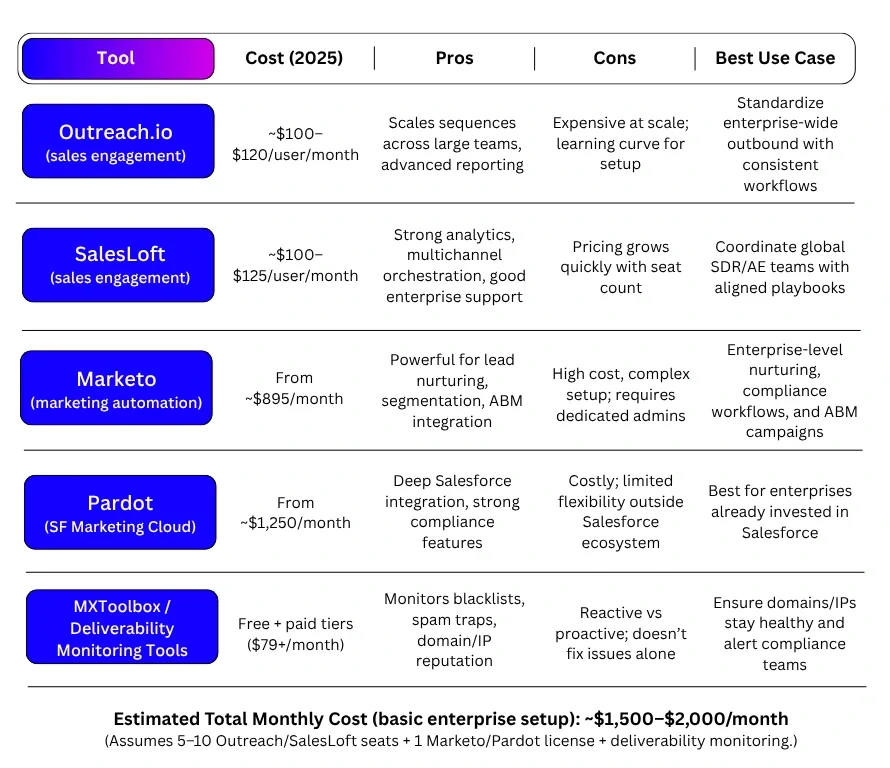
Email marketing benchmarks for Enterprises
ViB Tech’s 2025 B2B benchmarks: average enterprise open rate 20.8%, CTR 3.2%.
Enterprises with regional localization often achieve 30–40% open rates and higher engagement.
Domain rotation and deliverability monitoring can reduce blacklist incidents by 40%+ compared to static setups.
→ For enterprises managing multi-region pipelines and compliance, our Outsourced SDR Services provide governance, deliverability oversight, and consistent execution at scale.